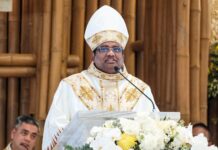

MANILA — The country’s Catholic bishops on Friday called for the enactment of a genuine and effective law against political dynasties, days after the Supreme Court ordered Congress to fulfill its constitutional duty to pass one.
The Catholic Bishops’ Conference of the Philippines (CBCP) said it could not remain indifferent to issues involving the moral foundations of society, human dignity, justice, equality and the common good.
“For these reasons, we support the call to enact a genuine, meaningful, and effective Anti-Political Dynasty Law that will faithfully give effect to the mandate of our Constitution,” the bishops said in a pastoral statement signed by CBCP president Archbishop Gilbert Garcera.
The bishops said political dynasties are “not merely a political question” but also a “moral and ethical concern,” arguing that the common good suffers when public authority is treated as private privilege.
“And when power becomes too concentrated, the institutions that should ensure accountability become vulnerable to patronage, favoritism, and particular interests,” they said.
‘Dapat Isa Lang’
The bishops particularly backed “Dapat Isa Lang,” a citizens’ initiative seeking to fulfill a constitutional mandate that has remained unaddressed for nearly four decades.
They described the initiative as a peaceful, lawful and democratic effort through which Filipinos can work toward fulfilling that mandate.
The Supreme Court ruled Sept. 16 that Congress has a mandatory constitutional duty to enact a law prohibiting political dynasties, saying its failure to do so for 39 years constitutes grave abuse of discretion.
Article II, Section 26 of the 1987 Constitution says the state shall guarantee equal access to opportunities for public service and prohibit political dynasties “as may be defined by law.”
The court said the provision imposes a mandatory duty on Congress, while leaving lawmakers to determine the definition and scope of the prohibition.
Dynasties widespread in gov’t
Political dynasties remain widespread across the country. Twenty of 24 senators, or 83%, belong to political dynasties, while about eight in 10 House district representatives come from political families.
Among local officials, 71 of 82 provincial governors, or 87%, and 113 of 149 city mayors, or 75%, belong to political dynasties, according to research by the Philippine Center for Investigative Journalism.
The bishops said the issue is not whether individual members of political families are qualified or capable, but whether political power becomes concentrated and repeatedly passed among relatives.
The CBCP urged dioceses, parishes, Catholic schools and universities, religious communities and lay groups to help people understand the initiative and participate responsibly.
It also called on Filipinos to reject misinformation, coercion, vote-buying, intimidation and political pressure while making their own decisions about the proposal.
The Dapat Isa Lang initiative seeks to limit political families to one national and one local elected post, ban relatives up to the fourth degree from simultaneously holding office, prohibit succession or position-switching, and impose a one-term cooling-off period.
“We, therefore, call upon all Filipinos to walk together in this common endeavor, guided by courage and conviction, sustained by hope, and united in our shared responsibility for the common good,” the bishops said.