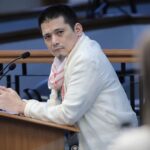

An interview featuring lawyer Jimmy Bondoc, the legal counsel of Sen. Ronald “Bato” dela Rosa and veteran journalist Ces Drilon went viral as the two discussed the arrest warrant issued by the International Criminal Court (ICC).
Bondoc appeared on One News’ “The Big Story,” where he was interviewed by Drilon about the implementation of the warrant against the senator, who is now on the ICC’s wanted list for his alleged involvement in the Duterte administration’s “war on drugs” campaign.
At one point in the interview, the lawyer explained why Dela Rosa cannot be tried in the Philippines.
“Sino po ang gusto niyo tanungin namin, out of fairness, kung bakit hindi dito sa Pilipinas kilitisin, sino po ang gusto niyo tanungin namin?” Drilon asked Bondoc.
“Ang gobyerno po. This is the people of the Philippines…,” Bondoc replied.
“Even the former justice secretary himself, Boying Remulla, who’s now Ombudsman, he himself said, hindi po kaya ng gobyerno. This is why the victims have gone to the ICC. For justice. Hindi ho kaya dito,” Drilon said.
“Bakit po?” Bondoc replied.The journalist then asked why he was directing the question at her, adding that the statement came from Remulla.
“And precisely why there is an ICC. I don’t know why you are framing it as a diminution of the Philippine sovereignty,” Drilon said.
Bondoc argued that the Philippines is no longer a member of the ICC.
“I beg you to understand. We withdrew…” he said.
Drilon then argued that the crimes had occurred before the Philippines withdrew from the Rome Statute.
Bondoc said that the Philippines “did not follow” the procedures for serving an ICC arrest warrant, to which Drilon pointed out that authorities were “trying to serve the warrant” at the time Dela Rosa was seeking the refuge in the Senate.
The discussion then turned into another exchange of words, with Bondoc insisting that the National Bureau of Investigation was not carrying a warrant.
Drilon then pointed out that they were already “running out of time” and asked why Dela Rosa did not face the issue and instead fled from the Senate’s protective custody.
Bondoc replied that the warrant should be served through “personal service,” prompting the journalist question how that could be done when the senator had already fled.
“That is the purpose of the lawyer,” Bondoc told her, saying that they can receive arrest warrants on behalf of their client. He also insisted that the serving of the warrant should follow proper procedures.
The clip went viral on social media, with several online users questioning the lawyer’s claim that attorneys can accept arrest warrants for their clients.
Grabe mejo naiyak ako kay ma’am ces. I’m so happy that there are still people with convictions and morals who are not afraid to speak out.
by
u/Mysterious_Pin_332 in
Philippines
“In what planet is this allowed? Sure, the lawyer of the accused may be present when — and only when — the subject of the arrest warrant elects to surrender himself to the proper authorities, but saying that the warrant should be handed over to the lawyer??? Crazy in so many levels!” an X user wrote.
“Rules of the DDS Court yata ang nabasa ni Jimmy Bondoc. Where on earth do you need to serve an arrest warrant to a lawyer? Nakakahiya!” another commented.
DDS refers to “Diehard Duterte Supporters.”
“Na-confuse ata ni attorney [ang] arrest warrant sa subpoena. Nasa Revised Rules of Criminal Procedure po, an arrest requires physical custody of the accused person. ‘Pag sayo po na-serve, attorney Jimmy, ikaw poposasan? Hahaha,” another Pinoy wrote.
Meanwhile, former Supreme Court Senior Associate Justice Antonio Carpio said there is such a thing as “universal jurisdiction” over crimes against humanity.
Dela Rosa is accused by the ICC of crimes against humanity of murder in connection with the “war on drugs” campaign he oversaw while serving as the Philippine National Police chief under then-president Rodrigo Duterte.
The former top cop implemented the operation and was widely reported as one of its key architects, during which the country saw extrajudicial killings allegedly carried out by the police.
“‘Yung crime against humanity, tinatawag natin ‘yang crime with universal jurisdiction. Ibig sabihin niyan, any country, where the person is found who is charged with crime against humanity, can be charged in that country,” Carpio said in an interview.
“‘Yung sinasabi nila na walang jurisdiction dahil wala pang warrant of arrest from a local court, hindi totoo’ yan, dahil this is a crime of universal jurisdiction,” he added.
The Philippine Act on Crimes Against International Humanitarian Law, Genocide and Other Crimes Against Humanity states that the government may turn over a person wanted by an international court or tribunal through extradition or surrender.